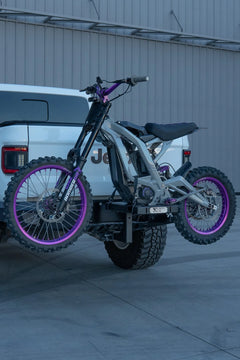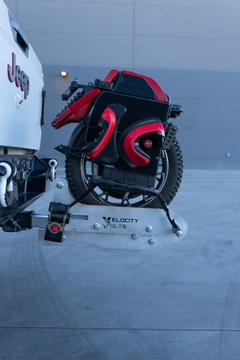

If you've ever stared at a carrier listing and wondered what "Class III" means - or whether your vehicle's hitch is even the right one - this is for you.
Hitch classes are one of the most common sources of confusion when buying any kind of hitch-mounted gear. Here's a clear breakdown, and what it means specifically for transporting an e-moto.
The Hitch Class System
In North America, receiver hitches are categorized by the size of their receiver opening and their rated towing and tongue weight capacity. There are five main classes.
Class I
Receiver size: 1-1/4 inch
Typical tow rating: Up to 2,000 lbs
Tongue weight: Up to 200 lbs
Found on smaller sedans and compact cars. Not suitable for most e-moto carriers. The receiver is too small for 2-inch shank equipment, and the tongue weight capacity is tight.
Class II
Receiver size: 1-1/4 inch (most common) or 2 inch
Typical tow rating: 3,500 lbs
Tongue weight: Up to 350 lbs
Common on midsize cars, small crossovers, and minivans. Class II hitches with a 2-inch receiver can work with e-moto carriers, but check your specific vehicle's tongue weight rating carefully.
Class III
Receiver size: 2 inch
Typical tow rating: 3,500 – 8,000 lbs
Tongue weight: Up to 800 lbs
The most common hitch class in North America. Found on full-size trucks, SUVs, crossovers, minivans, and many sedans. Class III is the sweet spot for e-moto transport. There's plenty of tongue weight headroom, a 2-inch receiver that fits a wide range of carriers.
Class IV
Receiver size: 2 inch
Typical tow rating: Up to 10,000 lbs
Tongue weight: Up to 1,200 lbs
Found on heavier trucks and SUVs. No issues with e-moto carriers - you have ample capacity to spare.
Class V
Receiver size: 2 inch or 2-1/2 inch
Typical tow rating: Up to 18,000+ lbs
Tongue weight: Up to 2,000 lbs
Commercial and heavy-duty truck territory. E-moto carriers are not the limiting factor here.
What Class Does Velocity Volts Support?
The Charge Carrier requires a 2-inch receiver and is rated for Class III, IV, and V hitches. Class II compatibility depends on your specific bike weight and your vehicle's tongue weight rating.
The 2-inch receiver is the standard across Class III, IV, and V - if your vehicle has any of those, you're compatible. Class II vehicles need a quick check of the tongue weight math.
The Tongue Weight Calculation
This is the number most people skip, and it's the most important one. Your vehicle's hitch has a rated tongue weight limit — typically stamped on the hitch receiver itself, or listed in your owner's manual.
To calculate your total tongue weight load:
- Find your vehicle's hitch tongue weight rating
- Add the carrier weight (Charge Carrier: 22 lbs)
- Add your bike's weight with the battery removed
The total must stay under your vehicle's tongue weight rating. With a 22 lb carrier and a typical 130 lb e-moto, you're looking at around 152 lbs - well within range for any Class III+ hitch.
How to Find Your Hitch Class
If you don't know what hitch class your vehicle has:
- Check the label stamped on the hitch receiver itself
- Look up your vehicle in the owner's manual under towing specifications
- Search your year/make/model on a hitch manufacturer's site
The receiver opening size is the fastest visual check - if it's a 2-inch square opening, you have a Class II (some), III, IV, or V hitch.
Quick Reference for E-Moto Riders
| Hitch class | Charge Carrier compatibility |
|---|---|
| Class I | Not compatible (wrong receiver size) |
| Class II (1-1/4" receiver) | Not compatible without a hitch adapter |
| Class II (2" receiver) | Verify tongue weight |
| Class III | Fully compatible |
| Class IV | Fully compatible |
| Class V | Fully compatible |
*Regardless of your hitch class, always verify your tongue weight capacity before using
Ready to find the right setup? Browse the Charge Carrier.