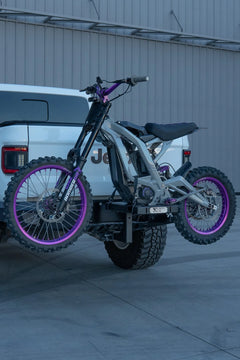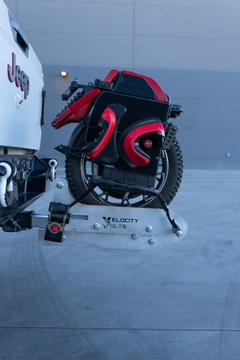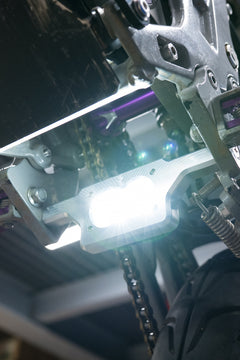

You didn't drop a few thousand dollars on an electric motorcycle to strap it to a beat-up trailer and hope for the best. Getting your e-moto to a ride destination safely, without scratching the bodywork, stressing the frame, or breaking the kickstand sensor - takes a carrier that was actually designed for the job.
This guide breaks down every hitch carrier option available to e-moto riders today, so you can make an informed decision before you spend a cent.
Why Generic Motorcycle Carriers Don't Work for E-Motos
Most hitch carriers on the market were engineered for full-size gas motorcycles — 400 to 800+ pound bikes with wide footpegs, no sensors to worry about, and a completely different geometry than a Surron, Talaria, or similar e-moto. When you bolt your electric bike to one of those racks, a few things happen:
- The carrier is vastly oversized for your bike's footprint, leaving it flopping around with only straps holding it in place.
- The ratchet strap tie-down points don't line up with how e-motos are balanced, creating load shift on the highway.
- The kickstand sensor - a standard feature on most e-motos - can get damaged when the bike doesn't sit level.
- The carrier itself weighs as much as some e-motos, eating into your hitch's tongue weight rating before you've loaded anything.
Purpose-built e-moto carriers solve these problems from the ground up. Here's how the current market breaks down.
Types of E-Moto Hitch Carriers
1. Purpose-Built E-Moto Carriers
This is the category Velocity Volts Charge Carrier occupies - carriers engineered specifically for the dimensions, weight range, and sensor requirements of electric motorcycles.
The Charge Carrier weighs 22 lbs and supports up to 400 lbs, meaning it adds minimal dead weight while handling virtually any e-moto on the market. It uses a Secure Anchor Bolt System that locks through the bike's foot pegs, providing a stable, balanced hold that doesn't rely on straps alone.
Critically, it features an adjustable mounting bracket system with 20 positions - designed to accommodate different peg heights, bash guards, and kickstand sensor placements without requiring modifications to your bike.
The Charge Carrier is the only carrier on the market with a purpose-built kickstand sensor solution, letting your bike sit level without bypassing or damaging the sensor.
2. Generic Tray-Style Carriers
Flat tray carriers are the most common option at big-box stores. They're inexpensive and work reasonably well for standard motorcycles. For e-motos, they present several drawbacks:
- No anchor points designed for e-moto footpeg geometry
- Reliance on ratchet straps that can loosen over long highway runs
- Heavy steel construction that cuts into tongue weight capacity
- No accommodation for kickstand sensors - the bike typically can't sit level
They'll technically hold your bike, but the setup is improvised at best.
3. Trailers
A utility trailer is overkill for most e-moto transport needs. They require a trailer hitch, a separate registration, backing skills, and significantly more storage space. For riders hauling multiple bikes or going on extended trips, they make sense. For weekly group rides, they're excessive.
Key Specs to Evaluate Any Carrier
Weight Capacity
Most e-motos fall between 100 and 200 lbs. Look for a carrier rated well above your bike's weight — the Charge Carrier's 400 lb limit gives you room to safely transport heavier bikes and isn't strained by the load.
Carrier Weight
Your vehicle's hitch has a tongue weight rating (typically 10–15% of its tow rating). Every pound the carrier weighs is a pound that isn't available for your bike. A 22 lb carrier like the Charge Carrier leaves far more capacity available than a 60 lb steel tray.
Mounting System
How the bike attaches to the carrier matters as much as how the carrier attaches to the hitch. Strap-only systems can shift. A bolt-through system that anchors to the footpegs is fundamentally more stable.
Kickstand Sensor Compatibility
If your bike has a kickstand sensor (most modern e-motos do), verify the carrier accommodates it. Generic carriers don't — which means you're either bypassing the sensor, risking damage, or rigging a workaround on the side of the road.
Storage Convenience
A carrier that folds up or reconfigures for storage when not in use is far more practical than one you have to fully remove. The Charge Carrier's Smart Storage Mode lets it sit vertically against the vehicle between rides.
Choosing the Right Carrier for Your Setup
Class III, IV, or V hitch: You have full flexibility. The Charge Carrier is compatible with all three.
Class II hitch: Compatibility depends on your bike's weight and your vehicle's tongue weight rating. Verify both before purchasing any carrier.
Single bike transport: The Charge Carrier handles this out of the box.
Two bikes: The Charge Carrier Add-On connects to the main carrier with four bolts, converting it to a dual configuration with 200 lbs per bike.
Ready to find the right setup? Browse the Charge Carrier.